The global electric vehicle (EV) hierarchy is entering a decisive reset. By 2026, the United States is expected to produce more lithium-ion batteries than it consumes, effectively ending its structural dependence on imports and reshaping competitive dynamics across the EV and energy storage value chain. While political narratives may differ on who deserves credit, the strategic outcome is clear: battery autonomy is becoming a pillar of US industrial power-and South Korean manufacturers are emerging as its biggest beneficiaries.
From Import Dependence to Structural Oversupply
For much of the past decade, US battery demand surged faster than domestic supply. Since 2021, the country has imported over $100 billion worth of batteries and components, with roughly half sourced from China. Lithium-ion battery shipments increased 15-fold between 2014 and 2024, alarming policymakers concerned about strategic vulnerability in both clean energy and national security.
That trajectory changed with the Inflation Reduction Act (IRA) of 2022, which fundamentally altered battery economics. Generous production and investment tax credits reduced US battery manufacturing costs by an estimated 30%, according to the Center on Global Energy Policy. Just as importantly, the legislation effectively excluded Chinese battery giants from accessing those incentives.
The result: a manufacturing buildout so rapid that analysts now expect US battery supply to exceed demand as early as 2026, according to Benchmark Minerals.
Why Korean Battery Giants Are the Real Winners
The biggest beneficiaries of America’s battery reindustrialization are not US startups-but South Korea’s battery champions: LG Energy Solution (LGES), Samsung SDI, and SK On.
Collectively, Korean firms have committed around $20 billion to US battery capacity expansion. Between 2025 and 2029, they are expected to account for more than 40% of US production growth. For LGES, the US became its largest market by sales in the first half of 2025, while SK On more than doubled its US capacity year-on-year.
This scale is translating directly into financial performance:
- LG Energy Solution is projected to swing from losses in 2025 to $700 million in net profit in 2026
- Samsung SDI is expected to generate nearly $400 million in profit
- SK On, while still loss-making, is forecast to grow revenues by around 50% year-on-year
Even as EV subsidies were rolled back in late 2025, growth in grid-scale energy storage-driven by AI data centers and power-hungry digital infrastructure-has absorbed capacity and stabilized demand.
Technology Catch-Up Without Chinese Competition
US battery autonomy has also created a rare strategic window: technology advancement without Chinese price pressure.
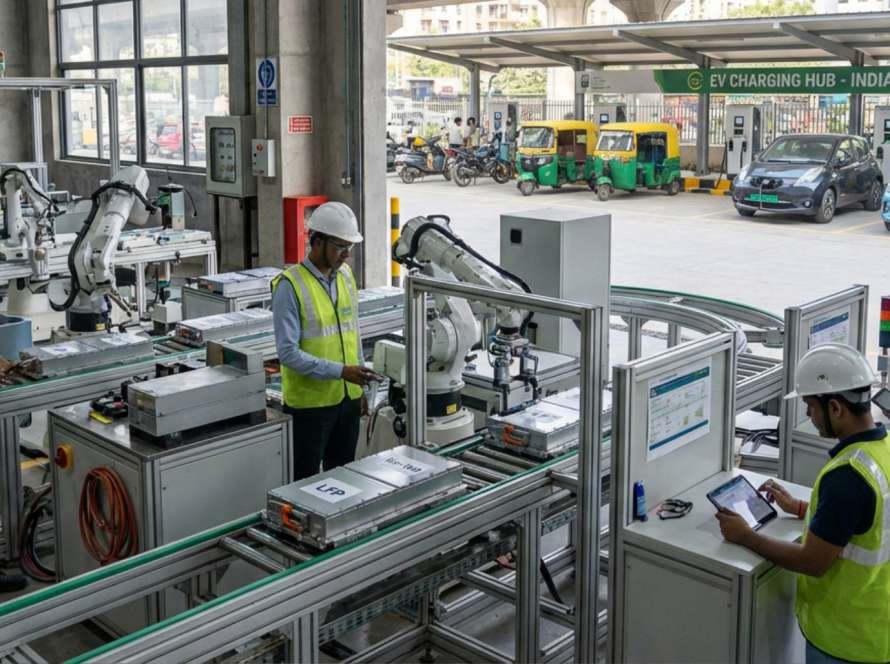
Historically, China dominated lithium ferrous phosphate (LFP) batteries-low-cost, long-life chemistries critical for mass-market EVs and energy storage. That advantage is eroding. LG Energy Solution is already producing LFP batteries in the US, Samsung SDI will follow in 2026, and SK On is actively negotiating with automakers.
Beyond LFP, the US has become a proving ground for next-generation chemistries, including lithium manganese–rich cells. Scale-driven R&D efficiencies and protected market access allow Korean firms to accelerate learning curves-knowledge that can later be exported to Europe and other major markets.
Key Forces Reshaping the EV and Battery Supply Chain
Strategic Risks That Could Still Disrupt the Narrative
Battery autonomy does not eliminate risk-it redistributes it.
If EV adoption slows materially or the AI-driven energy storage boom cools, oversupply could pressure margins, undermining profitability. More structurally, China retains leverage over critical raw materials, particularly graphite and processed lithium. Escalating trade tensions could still disrupt upstream supply chains.
Policy risk also remains asymmetric. While US incentives catalyzed growth, future administrations-American or foreign-retain the power to reshape market conditions quickly.
The Bigger Picture for Executives
For C-suite leaders, the takeaway is not just about batteries-it’s about industrial positioning.
US battery autonomy marks a shift from globalization to regionalized clean-energy supply chains, with allies-not domestic players alone-capturing value. Korean manufacturers have effectively embedded themselves into the US industrial base, gaining scale, profits, and technological momentum at China’s expense.
If current trajectories hold, the EV value chain of the 2030s will look fundamentally different from that of the 2010s-less China-centric, more regional, and increasingly shaped by policy-driven capital flows.In that future, battery autonomy will be the quiet force redefining global EV leadership.