India’s electric vehicle (EV) revolution is entering a critical expansion phase. A recent industry report projects that demand for EV batteries in India will grow more than 14 times over the next seven years, rising from around 17.7 GWh in 2025 to over 256 GWh by 2032.
This explosive growth highlights the rapid electrification of India’s automotive sector and signals that the country is on the verge of becoming a major player in the global EV battery supply chain-not just as an assembler, but as a large-scale consumer and manufacturer of battery cells and packs.
For C-suite leaders in automotive, energy, chemicals, and infrastructure, this shift represents a strategic inflection point: the EV battery is no longer a niche component, but a core driver of competitiveness, cost structure, and long-term market positioning.
Exponential Growth in EV Battery Demand
The report presents a highly bullish outlook for India’s domestic battery market:
- From 17.7 GWh to 256.3 GWh
Battery demand is expected to rise from about 17.7 GWh in 2025 to a staggering 256.3 GWh by 2032, a more than 14-fold increase in just seven years. - 35% CAGR
The market is projected to grow at a compound annual growth rate of 35% between 2025 and 2032, one of the fastest growth rates in the global EV ecosystem.
This trajectory suggests that India is moving beyond early-adopter EVs into mass-market electrification, where battery demand will be driven by millions of two-wheelers, three-wheelers, passenger cars, and commercial vehicles.
Key Drivers of the Surge
Several powerful forces are propelling this 14-fold growth in EV battery demand:
- Rising fuel costs
As the cost of running internal combustion engine (ICE) vehicles continues to rise, consumers are increasingly shifting to electric alternatives, where the cost per kilometer is significantly lower. - Strong government support
Policy initiatives such as production-linked incentive (PLI) schemes and demand-side subsidies are accelerating both manufacturing and adoption, creating a virtuous cycle of scale and affordability. - Aggressive new model launches
Automakers are rapidly rolling out affordable EV models across two-wheelers, three-wheelers, and passenger vehicles, expanding choice and driving volume growth. - Charging infrastructure expansion
The rapid build-out of public and private charging networks is reducing range anxiety and boosting consumer confidence in EVs, further accelerating adoption.
Together, these factors are transforming EVs from a premium or niche choice into a mainstream mobility option, with profound implications for battery demand.
Technological Shifts: The Rise of LFP and Sodium-Ion
A crucial enabler of this growth is the evolution of battery chemistry. The report highlights that Lithium Iron Phosphate (LFP) batteries are becoming the dominant technology in India, driven by their:
- Higher safety
LFP chemistry is inherently more stable and less prone to thermal runaway, making it ideal for high-density urban environments and two- and three-wheeler segments. - Lower cost
LFP cells are less dependent on expensive and geopolitically sensitive materials like cobalt and nickel, reducing both cost and supply chain risk. - Improved energy density
Newer generations of LFP cells are now achieving energy densities above 300 Wh/kg, enabling longer driving ranges and making them competitive with higher-energy-density chemistries in many applications.
Beyond LFP, the industry is also seeing a shift toward sodium-ion and solid-state batteries. These emerging technologies promise to:
- Further reduce costs by using more abundant and lower-cost materials.
- Reduce dependency on scarce raw materials like lithium and cobalt.
- Enable new form factors and performance characteristics for next-generation EVs and grid storage.
For executives, this means that the battery technology roadmap is no longer static; it is evolving rapidly, with multiple chemistries coexisting and competing across different vehicle segments and use cases.
The Road Ahead: Scaling Domestic Manufacturing
With a projected EV battery demand of over 250 GWh by 2032, the Indian auto industry faces a decisive moment. To meet this explosive demand and reduce reliance on imports, the focus must now shift to:
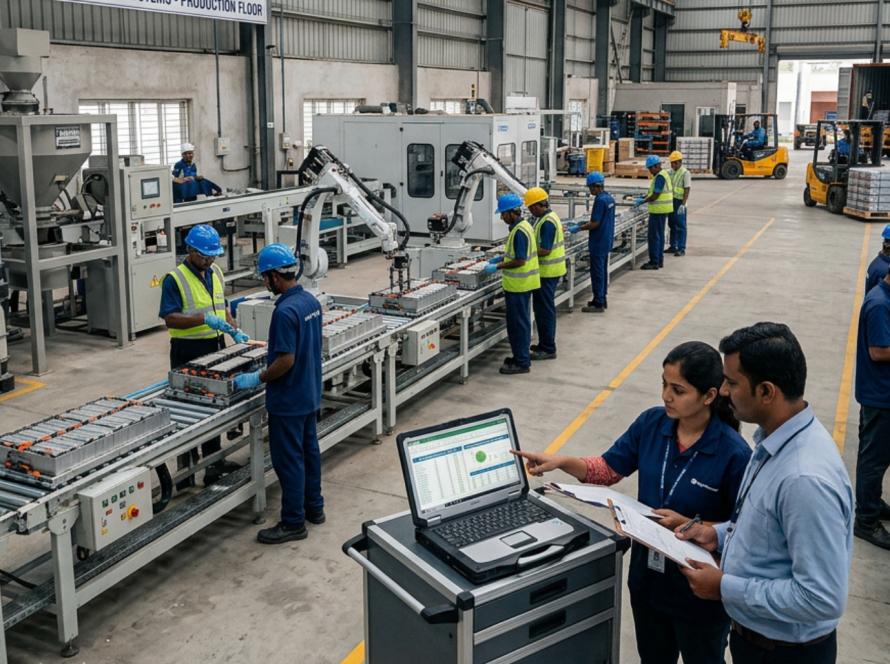
- Scaling up domestic cell manufacturing capacity
Building gigafactories and securing long-term offtake agreements to ensure that India can produce a significant share of the batteries it consumes. - Developing a robust domestic supply chain
Investing in cathode, anode, electrolyte, and separator production, as well as recycling infrastructure, to create a vertically integrated ecosystem. - Aligning with global trends
Designing battery packs and vehicle architectures that can accommodate multiple chemistries (LFP, NMC, sodium-ion, solid-state) to maintain flexibility and competitiveness.
For investors and stakeholders, this is not just a manufacturing opportunity-it is a chance to build a strategic, long-term position in one of the fastest-growing segments of the global energy transition.
Strategic Implications for C-Suite Leaders
For executives in automotive, energy, chemicals, and infrastructure, the 14-fold growth in India’s EV battery demand calls for:
- Reassessing EV and battery strategies
Align product roadmaps, fleet plans, and investment decisions with the projected scale of battery demand and the shift toward LFP and emerging chemistries. - Securing long-term battery supply
Negotiate long-term offtake agreements with domestic and international cell manufacturers to ensure supply security and favorable pricing. - Investing in domestic manufacturing and supply chain
Evaluate opportunities in cell production, materials, and recycling to capture value across the battery value chain. - Monitoring policy and regulatory developments
Track national and state-level policies on battery manufacturing, raw material sourcing, and recycling to anticipate regulatory requirements and incentive structures. - Preparing for a multi-chemistry future
Design vehicle and storage platforms that can support multiple battery chemistries, allowing for flexibility as costs, performance, and regulations evolve.
Looking Ahead
India’s projected 14-fold increase in EV battery demand by 2032 is more than a market forecast-it is a strategic signal that the country is entering a new phase of electrification. With a CAGR of 35%, this growth will reshape the automotive industry, the energy sector, and the broader industrial landscape.
For C-suite leaders, the message is clear: the future of mobility in India is electric, and the battery is at the heart of that transformation. Those who act now to understand, secure, and shape the EV battery ecosystem will be best positioned to lead in the next era of transportation and energy.
Building resilient battery supply chains through policy and manufacturing scale read more